
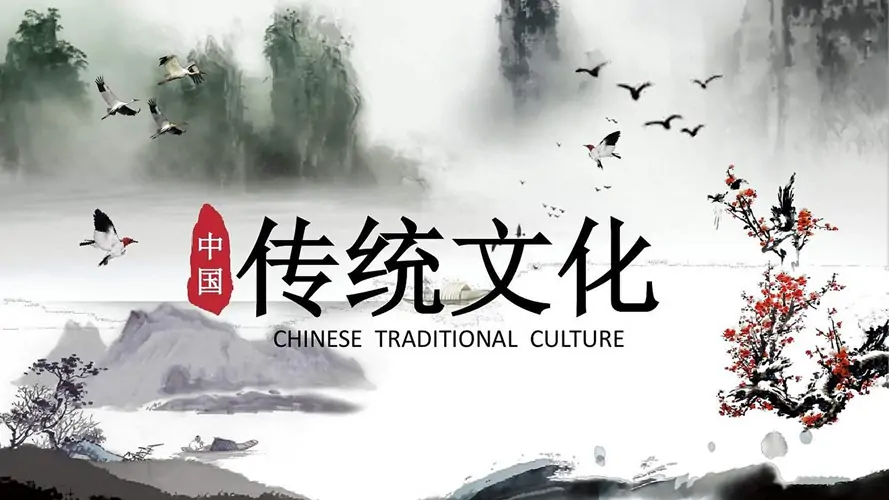
Chinese traditional culture refers to the sum total of material and spiritual achievements formed by the Chinese nation during its long historical development. In English, it is usually translated as “Traditional Chinese Culture” or “Chinese Traditional Culture”. It is based on the Central Plains culture and encompasses various aspects such as ideological concepts, ritual systems, literature and art, and folk festivals. It is the core manifestation of Chinese civilization.
Chinese traditional culture is extremely rich and can be viewed from three aspects: ideology, carriers, and daily life.
1、Ideological schools: The core includes Confucianism, Buddhism, and Taoism, along with the thoughts of other schools such as Legalism, Mohism, and Military Strategy.
(1) Confucianism emphasizes “ritual” and “benevolence”, influencing social ethics and political systems.
(2) Taoism advocates following nature, as seen in the ideas of “Tao Te Ching”.
(3) Buddhism is a product of the local adaptation of foreign culture, integrating with Confucianism and Taoism.
2、Cultural carriers: It is mainly passed down through four major categories of classics: classics, histories, collections, and commentaries.
(1) These include traditional literature such as “The Book of Songs”, “The Chu Ci”, Tang poetry, Song lyrics, Yuan opera, and Ming-Qing novels.
(2) There are also medical theory works such as “Huangdi Neijing”, and military books such as “Sun Tzu’s Art of War”.
3、Folk customs: They are reflected in traditional festivals and agricultural techniques.
(1) Festivals such as the Spring Festival, Lantern Festival, Qingming Festival, Dragon Boat Festival, Mid-Autumn Festival, and Double Ninth Festival all have specific customs.
(2) Ancient scientific achievements such as astronomy and calendar systems, as well as the Twenty-Four Solar Terms, are also important components.
If we were to list specific cultural symbols, the following ten traditional cultures are the most representative, covering various fields such as craftsmanship, art, medicine and entertainment:
1、Porcelain: China is known as the “Ceramic Kingdom” with superb porcelain-making techniques, making significant contributions to world civilization.
2、Embroidery: Including Suzhou Embroidery, Hunan Embroidery, Guangdong Embroidery, and Sichuan Embroidery, it is a treasure of traditional handicrafts.
3、Go: Originating from China, it has a history of over 4,000 years and is one of the “Four Arts” of ancient times (alongside music, chess, and calligraphy).
4、Tea: China is the homeland of tea, with tea culture encompassing tea ceremony, tea sets, tea poems, etc., dating back to the Shennong era.
5、Traditional Chinese Medicine: Based on the concepts of yin and yang and five elements, it uses observation, listening, questioning, and palpation for diagnosis and treatment, with representative works such as “The Yellow Emperor’s Inner Classic”.
6、Silk: China was the first to breed silkworms and produce silk, and the Silk Road is renowned worldwide. Silk products are comfortable and durable.
7、Martial Arts: Also known as Kung Fu, it can be traced back to the Shang and Zhou dynasties and emphasizes the unity of internal and external, as well as the integration of form and spirit.
8、Calligraphy: The art of writing Chinese characters, evolving from oracle bone script to regular script, cursive script, etc., is a unique form of visual art.
9、Paper-cutting: An ancient folk hollowing-out art, often used for festival decorations, expressing emotions of joy, anger, sorrow, and happiness.
10、Peking Opera: The first of China’s five major dramas, it is regarded as a national treasure, with roles divided into male, female, clown, and villain.
Compared with other cultures, Chinese traditional culture has several notable characteristics:
1、Long and continuous history: It has remained largely uninterrupted. Confucian culture even has a history of over 5,000 years.
2、Inclusive and integrated: Confucianism, Buddhism, and Taoism jointly support and integrate with each other, and absorb the excellent cultures of other ethnic groups.
3、Agricultural economic foundation: The traditional economic form was an agricultural economy, which influenced the political path and lifestyle.
4、Emphasis on ethics and morality: It emphasizes “rituals” as the essence of culture and attaches importance to family ethics and social order.