
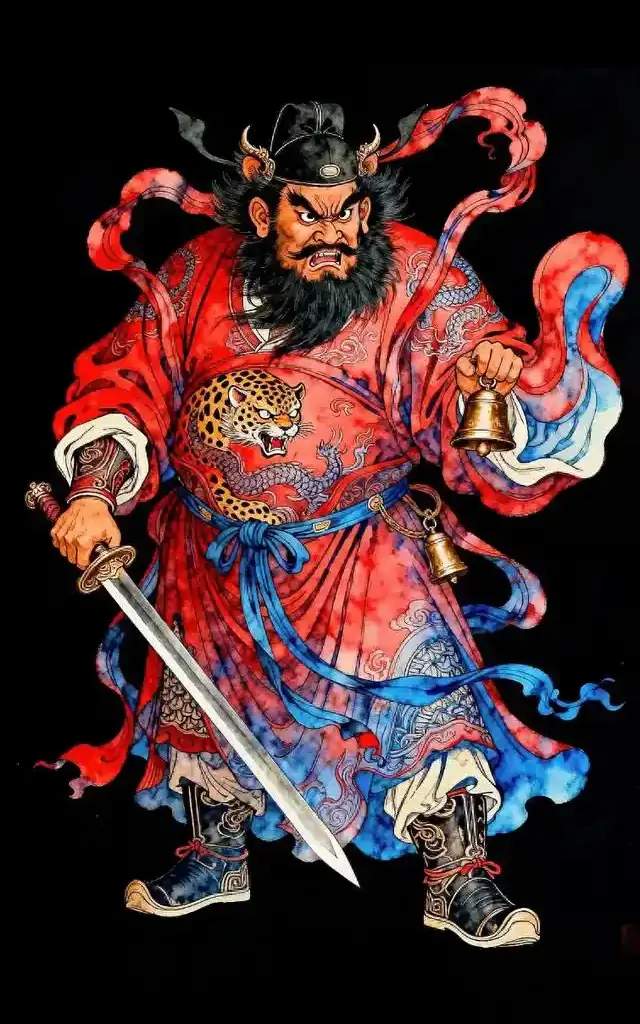
Zhong Kui is a popular deity in Taoism, whose duty is to subdue ghosts and dispel evil spirits. Statues and portraits of Zhong Kui are commonly hung among Chinese folk communities to ward off misfortune, and the legend of “Zhong Kui Capturing Ghosts” has been passed down through the ages.
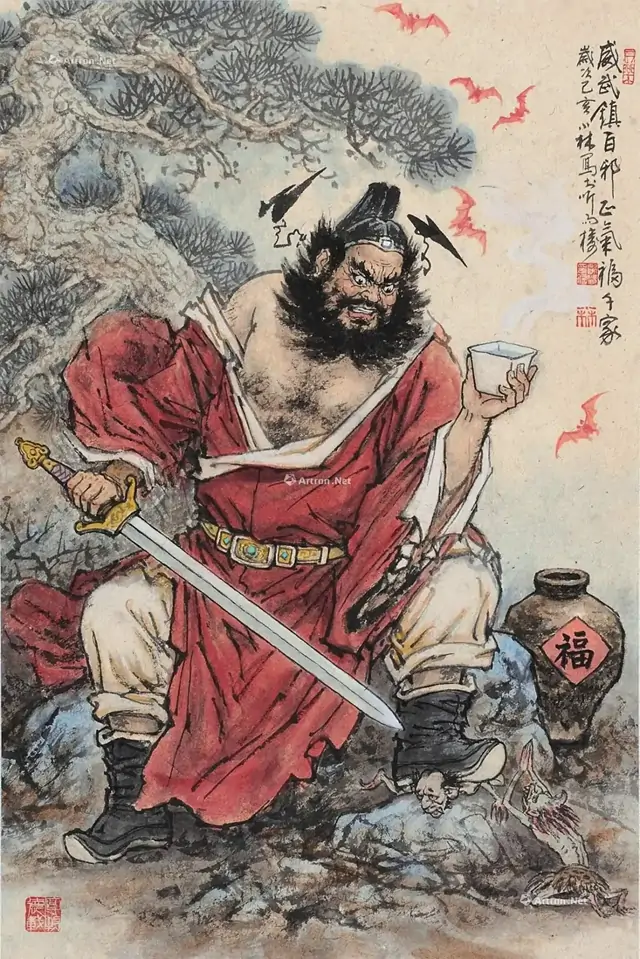
Regarding the legends of Zhong Kui’s life, A Brief Biography of Zhong Kui records: “Zhong Kui, surnamed Zhong and given name Kui, hailed from Zhongnan in Yongzhou in ancient times. Born and residing in Zhongnan, he excelled in both literary and martial arts. He had a leopard-like head, round eyes, an iron-dark face and shaggy whiskers, bearing an extraordinary appearance. Endowed with profound knowledge, he was upright and unyielding, fearing no evil. He treated others sincerely and loyally. He topped the list of recommended scholars yet failed to obtain the title of top scholar. His pleas fell on deaf ears, leaving him with no way to serve the nation. Choosing death for righteousness, he crashed into a palace pillar and died in anger. The emperor buried him with the honours of a top scholar. Later, he appeared in the emperor’s dream to drive away ghosts and cured Emperor Xuanzong of Tang of his illness. He was conferred the title of “Holy Lord Who Bestows Blessings and Guards the Household”. The emperor issued an imperial edict to the whole nation, ordering portraits of “Zhong Kui Bestowing Blessings and Guarding the Household” to be hung everywhere to preserve blessings, expel evil spirits and safeguard peace. Hence his fame spread far and wide!” Records in Comprehensive Records of Immortals Through Dynasties are highly similar: Zhong Kui was a native of Zhongnan in Shaanxi, displaying outstanding talent from an early age. During the Wude reign of the Tang Dynasty, he travelled to the capital for the imperial examination, only to be rejected because of his ugly looks. Overwhelmed by indignation, he crashed to his death on the palace steps. Upon hearing of this, the emperor granted him a burial in a red official robe. During the Tianbao reign, legend has it that Li Longji, Emperor Xuanzong of Tang, suffered from a spleen ailment during a stay at Lishan in Lintong that resisted all treatments. One night, he dreamed of a towering, imposing man catching a small ghost, gouging out its eyes and devouring it. The man introduced himself as Zhong Kui, a candidate who had failed the palace examination. The emperor recovered immediately upon waking. He then ordered Wu Daozi to paint the scene of Zhong Kui capturing ghosts from his dream, and hung the painting inside the palace to ward off demons and evil.
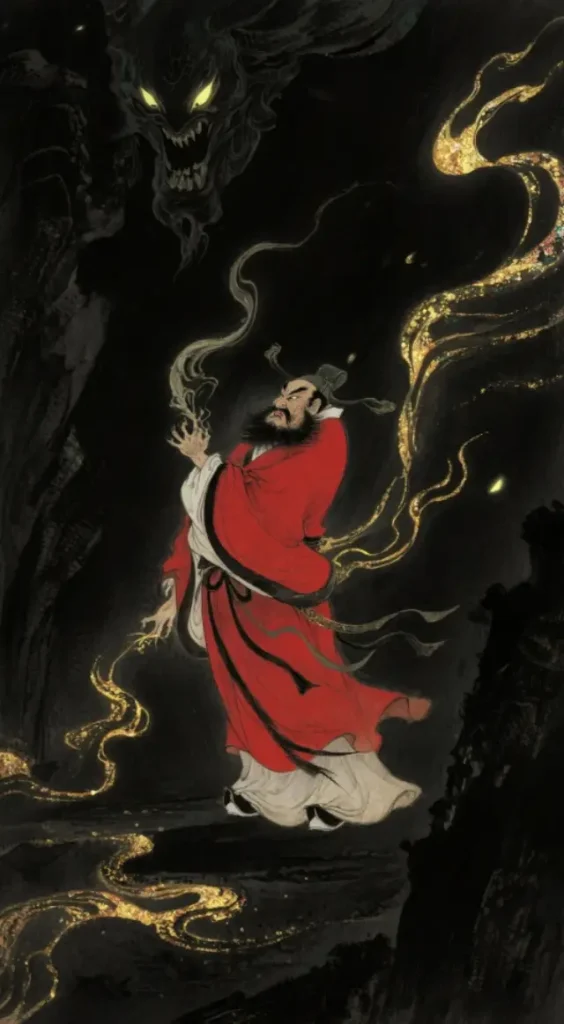
Thanks to the favour of Emperor Xuanzong, Zhong Kui’s status as the ghost-capturing deity gradually became established. It became a long-standing custom from the prosperous Tang Dynasty onwards for emperors to present portraits of Zhong Kui to ministers as New Year gifts. Surviving works such as thank-you notes for portraits of Zhong Kui and calendars were written by renowned figures including Zhang Yue during the Kaiyuan reign and Liu Yuxi of later times. Furthermore, a Tang manuscript Ritual Text of Zhong Kui Expelling Evil Spirits on New Year’s Eve was discovered among Dunhuang manuscripts, serving as solid evidence that Zhong Kui took a leading role in grand exorcism rituals.
Ancient legends tell of the Nian Beast that harassed mankind on New Year’s Eve. To drive it away, people stayed up all night observing Shousui. Starting from the Tang Dynasty, portraits of Zhong Kui, Shentu, Yulei, Qin Qiong and Yuchi Gong were pasted on doorways to fend off evil; firecrackers were set off and red lanterns hung to scare off the Nian Beast. During the Spring Festival, Zhong Kui acts as the deity guarding gates, preserving blessings, protecting households and repelling the Nian Beast. This shows that faith in Zhong Kui had become a widespread social custom at least from the high Tang period.
Later, Taoism enshrined Zhong Kui as a door god, appointing him a judge tasked with chasing ghosts and eliminating wickedness, and conferring upon him the title “Holy Lord Who Bestows Blessings and Guards the Household”. Folk people began hanging portraits of Zhong Kui to attract blessings and protect homes, and performing the Zhong Kui dance to pray for good fortune and dispel evil, a tradition that endures to this day.
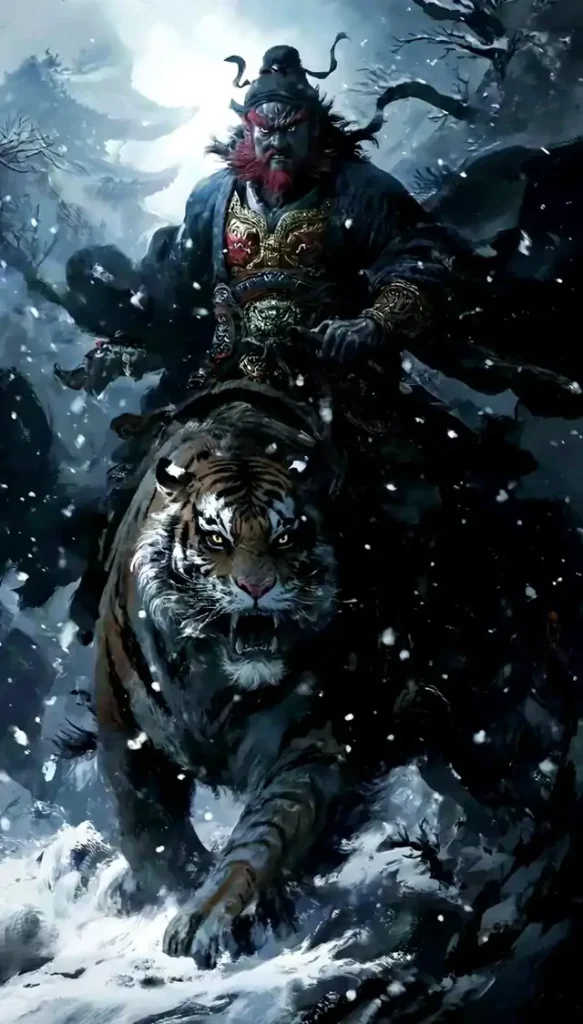
Zhong Kui has gradually become one of the most familiar figures in China’s folk popular deity beliefs. Mounted on doorways, he serves as a door god suppressing ghosts and countering evil; hung in central halls, he is a divine being eliminating disasters and malevolent forces; featured in exorcism rituals, he is a fierce general commanding ghosts and slaying demons. This has given rise to a rich variety of operas and paintings themed on Zhong Kui. Even the Compendium of Materia Medica records a “secret recipe”: burning portraits of Zhong Kui into ashes, mixing the ashes with water for oral administration, or blending them with other medicinal powders to make pills for difficult labour, malaria and other illnesses.
Belief in Zhong Kui thrives particularly in Zhouzhi of Shaanxi (the legendary hometown of Zhong Kui), the Jianghuai region, southern Fujian and Taiwan. During the Spring Festival, Dragon Boat Festival, groundbreaking ceremonies, shop openings, land-breaking rituals, business inaugurations, temple consecrations, opera premieres, earth-worshipping rites, house-moving celebrations, harvest festivals, weddings, birthday banquets, blessing ceremonies and other major events, people hang portraits of Zhong Kui and hold exorcism dance performances featuring Zhong Kui. Artists often dress up as Zhong Kui, wearing exorcism masks and official robes, holding a bat and a sword to perform ritual dances, symbolizing welcoming blessings and good fortune, longevity and bumper harvests, praying for fortune and dispelling evil, and safeguarding households. Sometimes string puppet shows featuring Zhong Kui are also staged.
Wherever overseas Chinese reside, faith in Zhong Kui can be found, and this belief is also prevalent across Southeast Asia. In Japan, the belief system surrounding Zhong Kui is well-developed. Many villages host Zhong Kui shrines and craft straw effigies of Zhong Kui. Roof tiles bearing images of Zhong Kui are installed on numerous tiled houses. Ritual dances of Zhong Kui are performed, and banners of Zhong Kui are displayed. Portraits of Zhong Kui are placed in children’s bedrooms. Shrine music societies stage performances centred on Zhong Kui, and there was even an aircraft model named after Zhong Kui.