
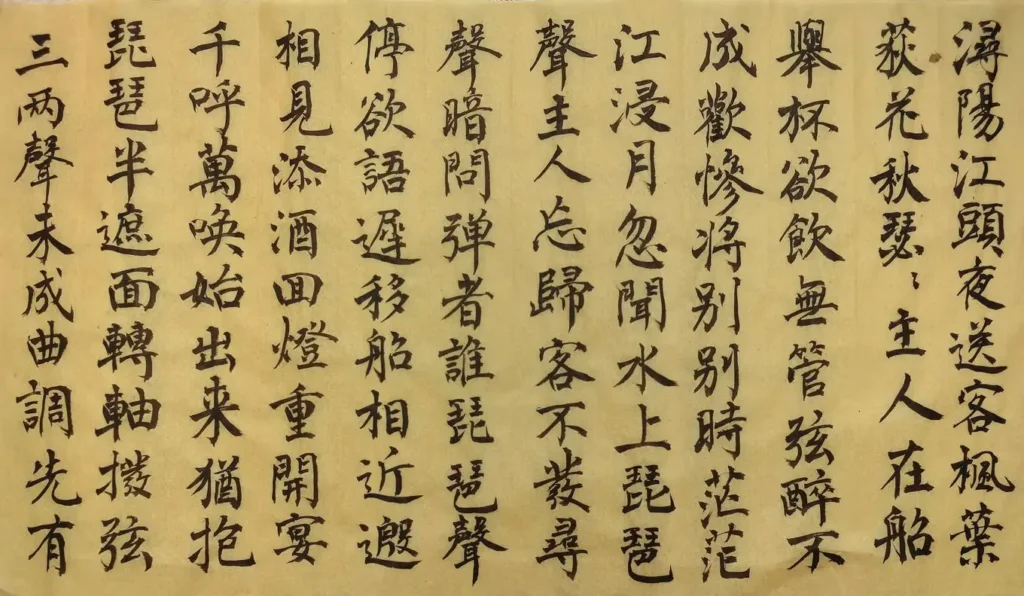
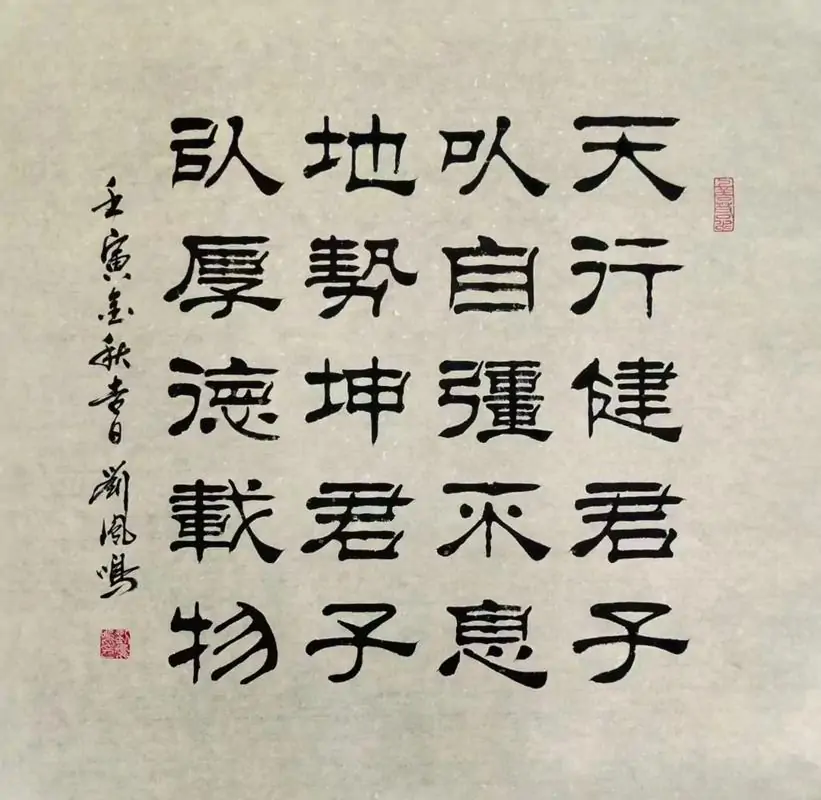
Chinese calligraphy is a unique art form that takes Chinese characters as its carrier and uses writing brushes for creation, translated as Chinese calligraphy in English. It is not only a national intangible cultural heritage of China but also inscribed on the Representative List of the Intangible Cultural Heritage of Humanity. As a core treasure of Chinese culture, it is far more than a writing skill; it integrates the calligrapher’s temperament and aesthetic taste, and is hailed as “poetry without words, music without sound”.
1、The Evolution of the Five Major Calligraphic Scripts
Chinese calligraphy has evolved alongside Chinese characters over more than 3,000 years, developing five classic scripts, each with distinct forms and applicable scenarios:
Seal Script: The earliest form of script, consisting of Great Seal Script and Small Seal Script, featuring smooth and rounded strokes. After Li Si standardized Small Seal Script in the Qin Dynasty, it became the official writing system.
Clerical Script: Widely used in the Han Dynasty. Its strokes turned rounded curves into angular turns and simplified complex structures, marking the origin of modern Chinese writing forms.
Regular Script: Originated in the late Han Dynasty and flourished in the Tang Dynasty. It features neat, square-shaped characters and straight strokes, making it the most commonly used handwriting style today.
Running Script: A hybrid between Regular Script and Cursive Script, easy to write and legible. Preface to the Lanting Collection by Wang Xizhi is known as “the No.1 Running Script under heaven”.
Cursive Script: Characterized by simplified structures and smooth, dynamic momentum, divided into Ancient Cursive, Modern Cursive and Wild Cursive, which best allows calligraphers to express their inner emotions.
2、Famous Calligraphers and Schools
There have been countless brilliant calligraphers throughout history, and distinct artistic styles and schools emerged in different eras, serving as vital references for calligraphy learning.
Representative Figures:
Qin and Han Dynasties: Li Si (Small Seal Script), Cai Yong (Clerical Script).
Wei and Jin Dynasties: Wang Xizhi (the Sage of Calligraphy), Wang Xianzhi, who set the standards for Running, Cursive and Regular Scripts.
Tang Dynasty: Ouyang Xun, Yan Zhenqing, Liu Gongquan and Zhao Mengfu, revered as the Four Masters of Regular Script.
Song Dynasty: Su Shi, Huang Tingjian, Mi Fu and Cai Xiang, collectively known as the Four Masters of the Song Dynasty.
Major Schools:
Traditional Systems: Stele Study and Calligraphy Model Scroll Study have long been the two foundational systems.
Regional Schools: The Songjiang School and Wu School emerged in the Ming Dynasty.
Modern Development: The contemporary calligraphy circle has spawned diverse branches including the Traditional Classic School and the Modern School.