
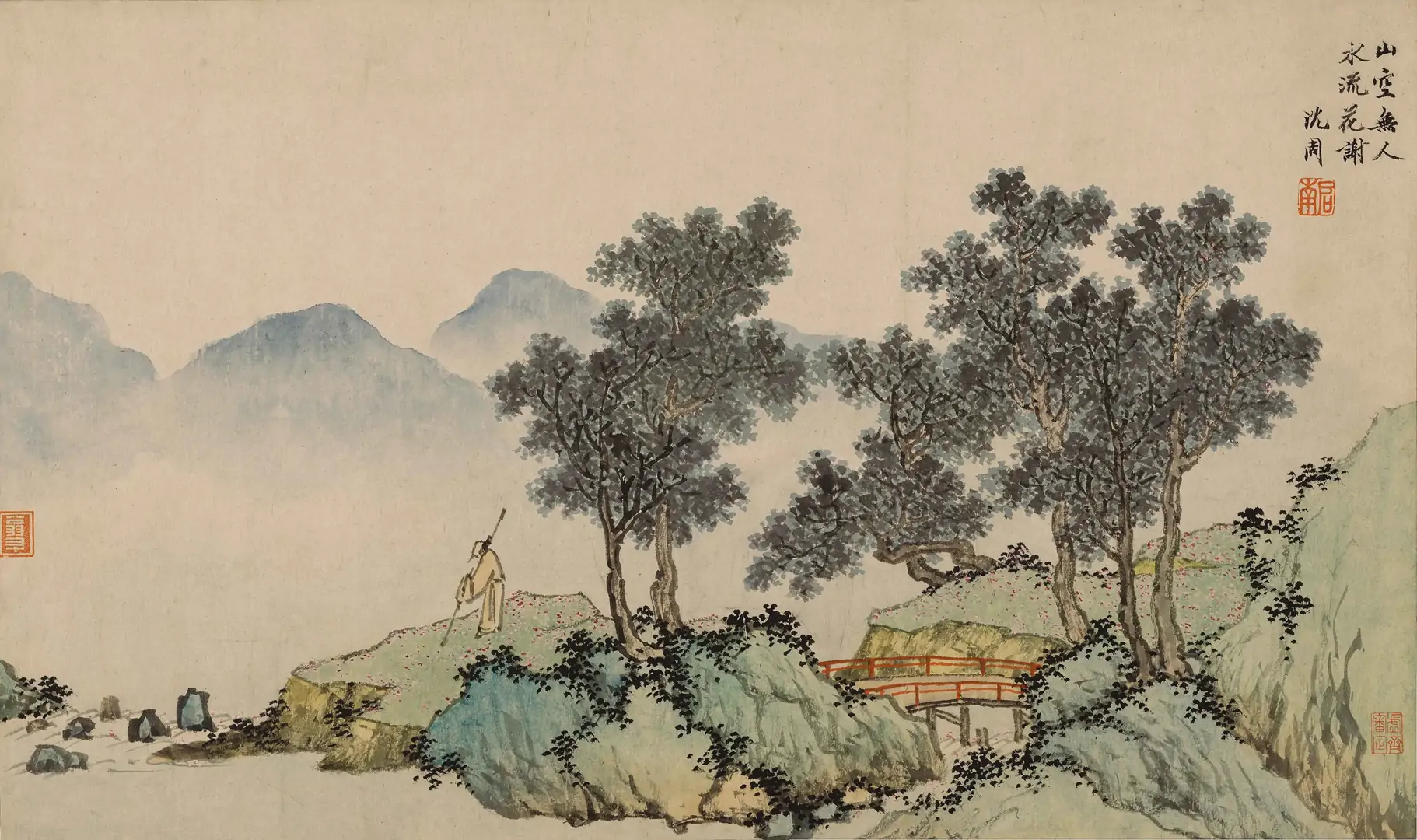
The Poem and Painting of Falling Blossoms by Shen Zhou of the Ming Dynasty, high-definition giclée reproduction landscape painting
Made of rice paper with inkjet printing; Artwork print only, unframed..
Size: 35.5cm*60cm.
The Painting of Falling Blossoms is one of the representative works of Shen Zhou, a painter of the Ming Dynasty. It mainly depicts a lonely scene in late spring with falling blossoms and an elderly man leaning on a walking stick gazing into the distance.
Shen Zhou, the founder of the Wu School of Painting in the mid-Ming Dynasty, courtesy name Qinan and art name Shitian, was born in Suzhou, Jiangsu. He was active in the mid-to-late 15th century. In his later years, he adopted a bold and unconstrained brushwork style featuring simplified strokes, known as the “Coarse Shen” style, and The Painting of Falling Blossoms stands as a typical work from this period.
The painting adopts a one-corner composition, with the right half presenting the main real scenery: five large trees arranged in two clusters, their leaves rendered with pepper dot texture and tinted with cyan and ochre. Terraces and mountain slopes interlace, connected by a small bridge scattered with pink falling blossoms. On the terrace to the left, an elderly man leans on his cane and looks afar, his solitary figure facing the misty distant mountains. The distant mountain hues are lightly washed with cyan, and blank space occupies the middle of the painting, guiding viewers’ eyes toward the elderly man in the foreground. An eight-character inscription by the artist himself reads: “Mountains lie empty of people; waters flow and blossoms fade.”
Shen Zhou painted this work in his eighties. Some hold that he created it upon seeing falling blossoms shortly after recovering from a serious illness. Other records state that when he was 76, his eldest son Shen Yunhong passed away. Grieving over outliving his child, he composed ten Poems on Falling Blossoms and created the matching painting. The work conveys melancholy for the passing of spring, using the image of falling blossoms to express reflections on the transience of life and the impermanence of human existence.
Reviews
There are no reviews yet.