
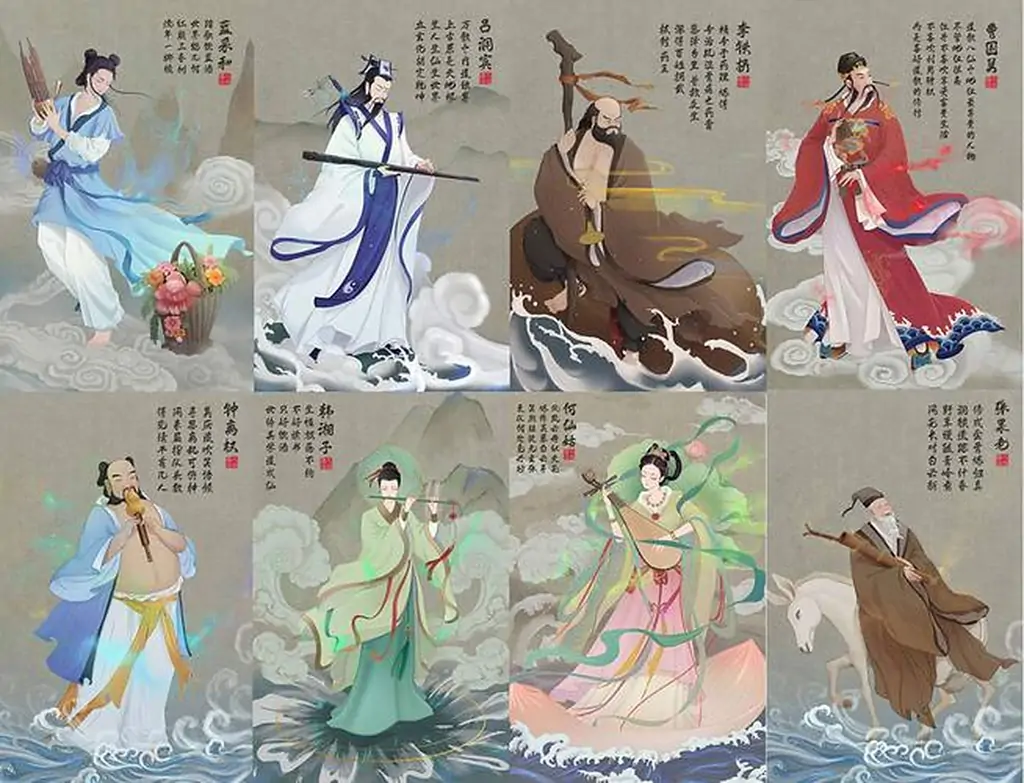
The Eight Immortals are eight widely known Taoist deities in Chinese folk legends.
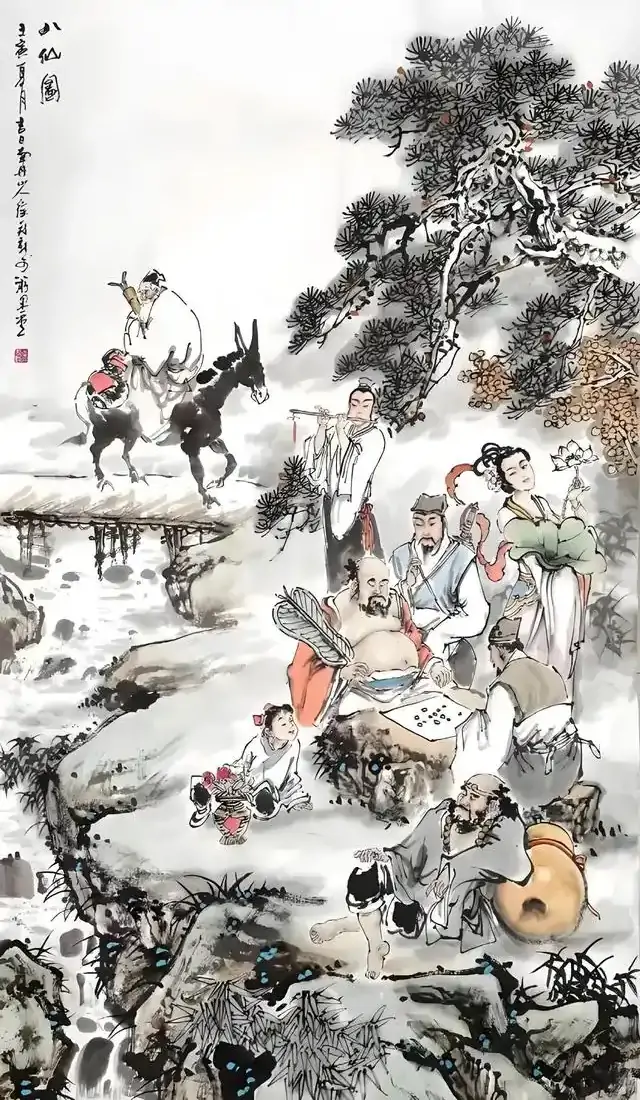
Unlike many other deities in Taoism, the Eight Immortals all originated from the mortal world and each has a rich and colorful earthly tale before attaining immortality. Their images are vastly different from the solemn and awe-inspiring portrayal of ordinary gods, which makes them deeply beloved by the common people. Among the Eight Immortals are a general, imperial relatives, a beggar, a Taoist priest and more. None were born immortals, and each has certain flaws. For instance, Zhongli Quan often bares his chest, Lü Dongbin is frivolous in disposition, and Tieguai Li is addicted to alcohol. The Eight Immortals also respectively represent men, women, the elderly, children, the wealthy, the noble, the poor and the humble. Most Taoist temples house shrines dedicated to the Eight Immortals, or build special Halls of the Eight Immortals for worship, and the Eight Immortals also appear at god worship fairs. They frequently feature in New Year paintings, embroidery, porcelain, lanterns and operas. According to legend, the Eight Immortals regularly attend the Queen Mother of the West’s Peach Banquet to offer birthday congratulations, so “the Eight Immortals Offering Birthday Greetings” has become a common birthday-themed motif in folk art. When people hold rituals to repay deities, operas known as “Eight Immortals plays” such as The Drunken Eight Immortals or The Eight Immortals Offering Birthday Greetings are often staged.
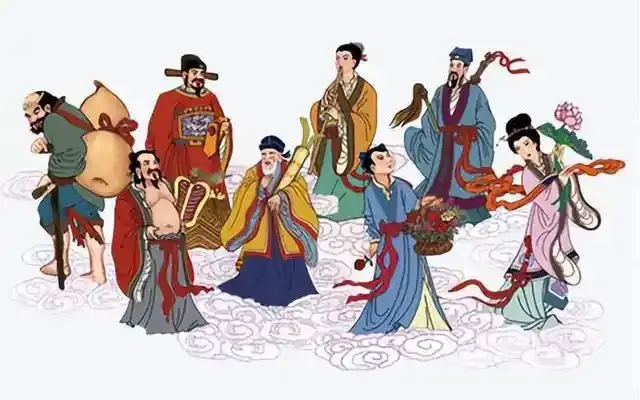
In folk legends, Tieguai Li ranks first among the Eight Immortals. Some books record that his surname was Li, given name Hongshui, known as Tieguai Li, a native of Xia in the Sui Dynasty. In A Brief History of Chinese Fiction, Lu Xun wrote that his surname was Li and given name Xuan. Zhao Yi’s Notes from Yu Studio states his surname was Liu. Some accounts claim he lived between the Kaiyuan reign of Emperor Xuanzong and the Dali reign of Emperor Daizong of the Tang Dynasty and practiced Taoism in the Zhongnan Mountains. Once, his primordial spirit left his physical body, only for his mortal form to be eaten by a tiger. He therefore had to inhabit the corpse of a lame beggar.
Comprehensive Mirror of Immortals Through the Ages records that he originally possessed a tall, imposing stature and dignified features and cultivated himself in a cave in Dangshan. He had agreed to attend the Immortal Assembly on Huashan Mountain hosted by Lord Laozi. Before departing, he told his disciple that if his primordial spirit failed to return within seven days, the disciple should cremate his mortal shell. He then left his body behind and set off with his primordial spirit. Unexpectedly, on the sixth day, messengers arrived with news that the disciple’s mother was critically ill. The disciple, left with no choice, burned the body and hurried home. Shortly afterwards, Tieguai Li’s primordial spirit returned, with no physical vessel to occupy. Suddenly he spotted the corpse of a starved man in the woods and entered through the forehead. Standing up, he realised his new appearance was grotesque. Hastily, he poured out the immortal elixir gifted by Lord Laozi from his gourd. Golden light shone from the gourd, reflecting his hideous new form: a dark-faced man with unkempt hair, shaggy whiskers, large glaring eyes, and a lame right leg.
He stood stunned when someone suddenly clapped behind him. Turning around, he saw none other than Lord Laozi. Panicking, Tieguai Li tried to withdraw his primordial spirit, yet Lord Laozi stopped him and said: “Cultivation lies not in outward appearance. With sufficient spiritual attainment, this form of yours shall become a wondrous manifestation of a true immortal.” Lord Laozi then bestowed upon him a golden headband to restrain his wild hair and an iron crutch to support his lame leg. Tieguai Li often carried a gourd slung over his shoulder, said to contain divine medicine that he brought down to the mortal world to heal the sick and rescue people in distress.
Zhongli Quan, known as Zhongli Quan the Elder, is second only to Tieguai Li in fame among the Eight Immortals and holds an eminent position within the group. The Quanzhen School of Taoism in the Yuan Dynasty revered him as the Ancestor of Yangzheng. Historical prototypes for him first emerged roughly between the late Five Dynasties and early Song Dynasty. Works including Xuanhe Chronicle, Records of the Strange, and History of the Song Dynasty document his deeds. Later, misrendering turned his name into “Han Zhongli Quan”, leading people to mistakenly believe he lived during the Han Dynasty.
According to Comprehensive Mirror of Immortals Through the Ages and Continued Comprehensive Examination of Literature and Documents, his full surname was Zhongli, given name Quan, courtesy name Jidao, art names Yunfangzi and Yangzhengzi. He was said to be a native of Xianyang in the Eastern Han Dynasty. His father Zhongli Zhang served as a general of the Eastern Han, and his elder brother Zhongli Jian was a Central Army Commandant, who also attained immortality in later years.
There was indeed a man named Zhongli Quan during the Tang Dynasty. Complete Tang Poems collects three of his jueju poems alongside a brief biography: “A native of Xianyang. He encountered an elder who passed on immortal secrets, and later met the True Man Huayang and the supreme immortal Wang Xuanfu. He received teachings and retreated into the Kongtong Mountains, adopting the art name Master Yunfang, and departed to immortality thereafter.” His surviving poems are titled Three Quatrains Composed to Escape in a Tavern in Chang’an, featuring lines such as “I always carry a pot of wine wherever I sit or lie, refusing to let my eyes behold the imperial capital” and “True immortals who have attained the Dao are hard to meet; when may I follow them away.”
Legends surrounding Zhongli Quan are vivid. It is told that one day, a giant strode into his mother’s inner chamber and proclaimed loudly: “I am the Divine Lord Huang of remote antiquity, to be reborn within you.” Immediately, blazing rays of strange light stretched several zhang high, and Zhongli Quan the Elder was born. At birth, he was as large as a three-year-old child, blessed with an auspicious physique: a rounded crown, broad forehead, thick ears, long eyebrows, a square jaw, full cheeks, vermilion lips, rounded shoulders and long arms. More strangely, he made no sound day and night, neither crying nor taking nourishment. On the seventh day, he suddenly spoke: “My spirit roams the Purple Mansion; my name is inscribed in the Jade Capital.” His parents were utterly astonished, for the Purple Mansion and Jade Capital referred to the celestial palaces of the Jade Emperor, leading them to believe he was an immortal reborn. Hoping he would wield great authority in adulthood, they named him Quan, meaning power.
As he grew, Zhongli Quan became a Remonstrance Censor in the imperial court. He was later ordered to campaign against the Tubo forces, suffered defeat, and retreated to seclusion in the Zhongnan Mountains. There he met the Eastern Emperor Wang Xuanfu, who imparted to him the true formula for immortality, secrets of golden elixir refinement, and the Azure Dragon Sword Art. Later he encountered the True Man Huayang, who taught him the Taiyi Nine Talismans, fire talismans and elixir arts, enabling him to comprehend the profound mysteries of the Dao. In the end, he obtained the secrets within a jade casket at the Four-Hao Peak of the Purple Forbidden Region in the Kongtong Mountains and achieved immortality. Legends recount that he initiated Lü Dongbin during the Tang Dynasty, and he ranks among the Five Northern Patriarchs of Taoism. Zhongli Quan is commonly depicted bare-chested, waving a palm-leaf fan, with large eyes and a ruddy face, two hair buns tied atop his head, bearing an easy demeanour like an unhurried commoner.
Zhang Guo Lao is the eldest immortal among the Eight Immortals. His given name was Zhang Guo; people respectfully called him Zhang Guo Lao owing to his advanced age. Zhang Guo was a real historical figure. The Imperial Edict Honouring the Immortal Zhang Guo, Issued by Emperor Xuanzong of the Tang Dynasty, compiled during the Kaiyuan reign, records that he “came from Guangzong in Xing Prefecture”, present-day Zhangguzhai Village in Guangzong County, Hebei Province, and biographies of him appear in both the Old and New Books of the Tang Dynasty.
During the reign of Wu Zetian, Zhang Guo lived in seclusion in the Zhongtiao Mountains. Everyone claimed he possessed secret arts of longevity, and he claimed to be hundreds of years old. Wu Zetian dispatched envoys to summon him, yet Zhang Guo Lao feigned death and refused to attend. In the twenty-first year of the Kaiyuan reign of Emperor Xuanzong, Wei Ji, Governor of Heng Prefecture, submitted reports of his extraordinary deeds to the throne. The emperor summoned him once more, and Zhang Guo again pretended to perish, remaining seemingly lifeless for a long time before reviving. The envoys dared not press him further. Upon hearing this, the emperor sent Xu Qiao to invite him again, leaving Zhang Guo with no choice but to travel to the capital.
Sceptical of the tales surrounding Zhang Guo, Emperor Xuanzong ordered Xing Hepu, skilled at calculating lifespans and fortune, to cast his horoscope. Yet Xing Hepu could not determine his age. The emperor also summoned a Taoist master known as Yeguang, who possessed the ability to see ghosts, and bade him observe Zhang Guo. Yeguang asked, “Where is Zhang Guo?” unable to spot him even standing face-to-face.
Extensive Records of the Taiping Era writes that Zhang Guo Lao claimed to have lived in the time of Emperor Yao. Emperor Xuanzong asked the sorcerer Ye Fashan about Zhang Guo’s origin. Ye Fashan replied: “I dare not speak, for I shall die the moment I tell you.” After being pressed, he said, “Zhang Guo is the essence of a white bat born at the dawn of chaos.” As soon as the words left his mouth, he collapsed lifeless on the ground. Only after the emperor pleaded on his behalf did Zhang Guo restore him to life.
Legends describe Zhang Guo Lao often carrying a storytelling tube slung over his back, riding a white donkey backwards as he wandered across the land, singing Taoist ballads to enlighten mortal beings. The popular saying “riding a donkey while reading a libretto” originates from this tale. The white donkey he rode could travel ten thousand li in a single day. At night, he folded it flat like paper and stored it inside a chest. When he wished to ride it again by day, he sprayed water from his mouth onto the paper, and it transformed back into a living donkey. A later poet wrote:
Countless people fill the world,
None like this old man.
He rides his donkey backwards,
To bid all things be viewed in retrospect.
No other member of the Eight Immortals has as many circulated stories as Lü Dongbin. Within Taoism, the Quanzhen School honours him as the Patriarch of Chunyang, also known as Ancestor Lü. Lü Dongbin hailed from Hezhong Prefecture in Pu Province, present-day Yongle Town in Ruicheng, Shanxi Province. His original name was Lü Yan, courtesy name Dongbin, Taoist art name Chunyangzi, also called Huidaoren. As a founding patriarch of Quanzhen Taoism, he is one of the renowned immortals of Chinese legend and among the Eight Immortals, occupying an extremely important position in both Taoist doctrine and folk belief. Poems attributed to him appear in Complete Tang Poems and Anthology of Ci Poetry. Works including Luo Dajing’s Whisperings from the Crane Forest, Hong Mai’s Records of the Strange, and Biographies of Immortals document his life.
Lü Dongbin passed the imperial examination during the Xiantong reign of the Tang Dynasty and served as county magistrate twice. Some accounts state he was a native of Jiujiang, originally a member of the imperial Li clan. Fleeing persecution under Empress Wu Zetian, he changed his surname to Lü and was first named Shaoguang. After failing the civil service examinations for more than twenty years, he abandoned official ambitions and roamed the realm. He was later enlightened to the Dao by Zhongli Quan.
Lü Dongbin is the most humanistic of the Eight Immortals: unrestrained and witty, he eliminates tyrants, protects common folk, subdues demons and monsters, and also enjoys wine and romantic encounters. The folk legend Lü Dongbin Teases White Peony Three Times has been widely passed down. Though legends about him are numerous and varied, they suggest he was originally a Tang Dynasty scholar who yearned for the Dao and was later deified by the people. To this day, the Lü Zu Temple at Yuanjiashan, constructed by Yuan Keli, Minister of War of the Ming Dynasty to worship Lü Dongbin, still stands in Sui County, Henan Province.
Legend holds that when Lü Dongbin’s mother was about to give birth to him, exotic fragrance filled the chamber, celestial music echoed through the air, and a white crane descended from heaven, vanishing as it flew into the curtains of her bed. Upon his birth, Lü Dongbin bore extraordinary bearing. Clever from childhood, he could memorise ten thousand words each day, recite texts after a single reading, and compose verses extemporaneously. When fully grown, he stood eight chi and two cun tall, often wearing a Huayang headscarf. While he was still an infant, Master Ma saw him and remarked: “This boy possesses an extraordinary bone structure, destined for great things among mortal travellers. In time, he shall settle where he meets Lu; he shall seek guidance when he encounters Zhong. Remember these words well.”
Later, Lü Dongbin travelled to Lushan Mountain, where the True Man Huolong passed down the Heavenly Escape Sword Art to him. At the age of sixty-four, he visited Chang’an and met a Taoist priest clad in blue outer robes and white inner garments writing poetry on a tavern wall. Struck by the priest’s singular appearance and elegant verses, Lü Dongbin asked for his name. The Taoist introduced himself as Master Yunfang, dwelling on Heling Ridge in the Zhongnan Mountains, and asked whether Lü Dongbin wished to journey with him. Still bound by mortal desires, Lü Dongbin declined. This Master Yunfang was none other than Zhongli Quan.
That night, Zhongli Quan and Lü Dongbin lodged together in the tavern. Zhongli Quan set about cooking alone while Lü Dongbin fell asleep. In his dream, he topped the imperial examinations as the top scholar, achieved brilliant success in officialdom, enjoyed a full household of descendants, and revelled in boundless prosperity. Suddenly he was convicted of a grave crime; his property was confiscated, his family torn apart. In his old age, he was left utterly alone, impoverished and destitute, shivering in wind and snow. As he was about to sigh, he awoke abruptly. The millet porridge Zhongli Quan had begun cooking was not yet ready. Zhongli Quan then inscribed a poem: “The yellow millet still remains uncooked; in one dream I journeyed to the Huaxu Kingdom.”
Lü Dongbin exclaimed in surprise: “Could it be that you know what I dreamed?”
Zhongli Quan answered: “In your dream just now, you witnessed countless shifts of fortune and misfortune, glory and disgrace. Fifty years passed in the blink of an eye. Gains are unworthy of joy, losses unworthy of grief. Human life is but a dream.”
Persuaded, Lü Dongbin resolved to learn the Dao under Zhongli Quan. After enduring the “Ten Trials”, he finally received Taoist teachings from his master. Armed with magical arts and the Heavenly Escape Sword Art, Lü Dongbin vanquished evil spirits and brought blessings to ordinary people. The Quanzhen School lists him among the Five Northern Patriarchs: Wang Xuanfu, Zhongli Quan, Lü Dongbin, Liu Haichan and Wang Chongyang.
He Xiangu is the only female among the Eight Immortals, and multiple versions exist regarding her origins. One account places her in the Tang Dynasty. In early Song times, Extensive Records of the Taiping Era quotes Records of Wondrous Encounters, telling of a woman named He Erniang, a peasant who wove shoes for a living. Growing weary of domestic confinement, she travelled to Luofu Mountain and resided in a mountain temple, regularly gathering wild fruits to feed the monks. Once, monks from a temple in Xun Prefecture, four hundred li away, visited the Luofu Mountain monastery. They said a celestial maiden had picked bayberries at their temple on a certain day. The date matched exactly when Erniang had gathered fruit. Since no one could explain where she obtained such an abundance of wild fruit, everyone concluded she was the immortal maiden who had picked fruit in Xun Prefecture. She became widely renowned and no longer needed shelter within the temple.
Another tradition dates her to the Song Dynasty. Numerous literary notebooks from the Song era describe her as a native of Yongzhou, present-day Lingling, in the Northern Song. Some say she met an extraordinary person in childhood and attained immortality after eating a divine peach. Others relate that while herding livestock in the countryside, she received immortal jujubes from a mysterious stranger and achieved immortality upon eating them. Song-era notebooks also record incidents where He Xiangu foretold fortune and misfortune for others, attracting crowds of scholars and curious visitors seeking her divination.
Continued Comprehensive Examination of Literature and Documents records that He Xiangu lived in Zengcheng County, Guangdong during the reign of Wu Zetian of the Tang Dynasty. Six streaks of divine radiance rose above her head at birth, marking her destined for immortality. At thirteen, she met a Taoist in the mountains and ate a divine peach offered by him. From then on, she felt neither hunger nor thirst, her body moved as lightly as flying, and she could foresee mortal blessings and disasters. She was later summoned to the imperial capital but vanished along the way.
Another legend states her given name was He Xiugu. Purple clouds swirled around her chamber at the moment of her birth. Quick-witted and brilliant from youth, at fifteen she dreamed a deity instructed her to consume mica powder. Afterward, she could leap lightly between mountain peaks. Each dawn she ventured out, returning at dusk with wild fruits to honour her mother. Later she ceased eating mortal food and spoke strangely. Upon hearing of her, Wu Zetian dispatched envoys to summon her, yet she disappeared midway. Some claim she ascended to immortality on the eighth day of the eighth lunar month during the reign of Emperor Zhongzong of the Tang Dynasty. One further tale holds that the Taoist she encountered was the immortal Lü Dongbin, who later guided her to immortality.
Among the Eight Immortals is a carefree beggar Taoist who appeared half-mad, known as Lan Caihe. Works including Shen Fen’s Continued Biographies of Immortals of the Southern Tang, early Song’s Extensive Records of the Taiping Era, and Lu You’s History of the Southern Tang record his deeds. He lived sometime between the late Tang and Five Dynasties. Lan Caihe wandered without a fixed home, his behaviour eccentric: fond of wine and singing. He usually wore a tattered blue robe, one foot shod and the other bare. Even stranger, he donned cotton clothing in summer yet lay in snow in winter, his whole body radiating warmth, as documented in Continued Biographies of Immortals.
He carried a bamboo clapper over three chi long, beating rhythm as he sang and begged along streets. Many of his impromptu songs struck listeners as profoundly mysterious, steeped in immortal sentiment. One verse runs:
I sing and wander, Lan Caihe,
How long shall this world endure?
Youth blooms like spring trees,
Time slips away like a tossed shuttle.
Ancient folk depart and never return,
Countless newcomers fill the earth.
At dawn I ride phoenixes across blue waves;
At dusk I witness white tides cover mulberry fields.
Bright radiance hangs in the sky,
Palaces of gold and silver tower grand and high.
Though Lan Caihe acted like a madman, when passersby gave him money, he mostly distributed it to the destitute.
Another legend claims Lan Caihe was the reborn Barefoot Immortal, ceaselessly travelling the world. People saw him both in childhood and old age, yet his appearance never changed. Later, he sang while drinking in a tavern in Haoliang. Amid the sound of cranes, sheng and xiao music, he suddenly rose lightly into the clouds. Casting down his boots, robe, sash and clappers, he drifted upward and vanished.
Han Xiangzi of the Tang Dynasty, courtesy name Qingfu, ranks among the Eight Immortals of ancient Chinese folk tales. Some identify him as the grandnephew of Han Yu. Han Xiangzi excelled at playing the vertical bamboo flute and studied the Dao under Lü Dongbin. Tradition credits him with composing the Taoist musical piece Ode of Heavenly Blossoms.
Legends depict Han Xiangzi as a handsome young man holding a long flute. An Minister Anfu of the Han Dynasty had a daughter named Lingling, beautiful and talented, engaged to Han Xiang. However, the Han Emperor wished to wed her to his imperial nephew. Minister Anfu firmly refused. Enraged, the emperor dismissed Han Xiang from office and exiled him. Lingling died of sorrow. Han Xiang was reborn as a white crane. Guided by Zhongli Quan and Lü Dongbin, the crane was reborn as the son of Han Hui of Changli County, infant name Xiangzi. Losing his father young, he was raised by his great-uncle Han Yu.
Upon reaching adulthood, Han Xiangzi received cultivation teachings from immortals Zhongli and Lü. Han Yu strongly opposed his pursuit of the Dao, so Han Xiangzi left home to cultivate in seclusion in the Zhongnan Mountains. He attained enlightenment and secured a place among the Eight Immortals. Several times Han Xiangzi manifested in different forms to guide his great-uncle Han Yu, yet Han Yu failed to comprehend the truth. Later demoted and travelling to Chaoyang, Han Yu became trapped at Blue Pass by heavy snow, freezing amid drifts. Han Xiangzi rushed to rescue him and guided him toward enlightenment. Han Yu finally awakened and also cultivated to become an immortal.
Cao Guojiu, last in the ranking of the Eight Immortals, appeared in legends later than the others, with fewer popular tales told of him. Accounts of his origins are broadly similar, connected to Empress Cao of Emperor Renzong of the Song Dynasty. The History of the Song Dynasty contains his biography. His given name was Cao Yi, courtesy name Gongbo, grandson of Cao Bin and younger brother of Empress Cao. Gentle and affable, versed in music and fond of poetry, he was ennobled Prince of Jiyang. He enjoyed smooth official service through several reigns and passed away peacefully at seventy-two.
Comprehensive Mirror of Immortals records that Cao Guojiu possessed an innately pure nature. He cared nothing for wealth and rank and yearned for immortal cultivation. In contrast, his younger brother acted recklessly and abused his power. Ashamed of his sibling’s misdeeds, Cao Guojiu retreated into the mountains to cultivate. He met Zhongli Quan and Lü Dongbin, who accepted him as their disciple, and he soon achieved immortality. The account in Journey to the East largely matches this record.
Cao Guojiu is traditionally portrayed wearing an official gauze hat and crimson robe, holding yin-yang jade tablets, his attire vastly different from the other immortals. While meditating among rocky mountains, he encountered Zhongli Quan and Lü Dongbin. They asked him: “We hear you cultivate yourself. What do you nurture?”
He replied: “I nurture the Dao.”
The immortals pressed: “Where is the Dao?”
Cao Guojiu pointed upward toward heaven.
They asked again: “Where lies heaven?”
Cao Guojiu pointed to his own heart.
The two immortals smiled and said: “The heart is heaven, heaven is the Dao. You have grasped the true meaning of the Dao.” They then imparted to him secret arts of returning to primordial truth and guided him to immortality.
A separate tradition states that when Cao Guojiu left officialdom to cultivate, the emperor granted him a golden tablet. Later, lacking fare to cross the Yellow River, he offered it as security. By chance he met Lü Dongbin travelling alongside him. Through this encounter, he awakened to the Dao and earned his place among the Eight Immortals.
“The Eight Immortals” refer to eight deities in ancient mythology: Zhongli Quan, Zhang Guolao, Li Tieguai, Han Xiangzi, Cao Guojiu, Lü Dongbin, Lan Caihe and He Xiangu. Legend has it that each of the eight immortals possessed unique mystical arts and boundless supernatural powers. They punished evil and promoted good among mortals and performed numerous benevolent deeds for common people.
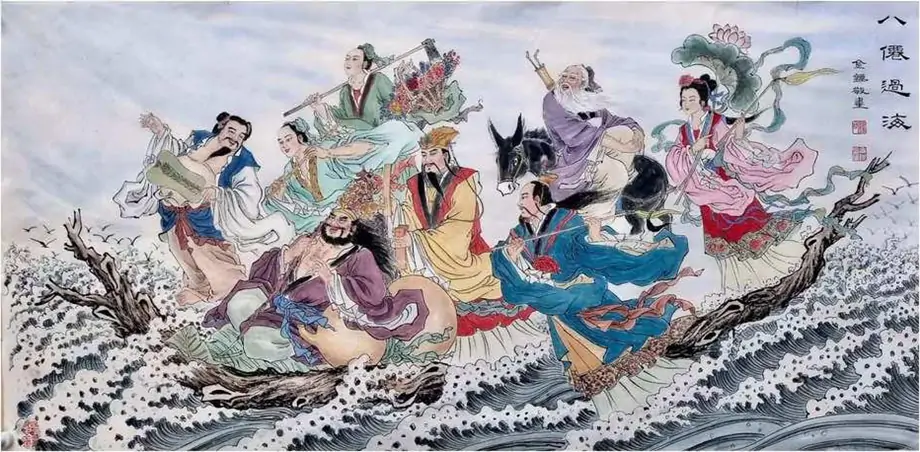
According to legend, one year, the Queen Mother of the West held her Peach Banquet, to which the eight immortals were invited. Each left their place of cultivation and planned to travel by cloud to attend the banquet. As they crossed the East China Sea, they beheld its vast, boundless waters with raging waves and roaring billows, a breathtaking sight. Lü Dongbin suddenly had an idea and said, “Crossing the sea on clouds is no true feat for immortals. Let us bring forth our respective magic treasures, tread the waves to cross the sea, and each display our divine power. What say you?” The other immortals replied in unison, “Agreed!”
Li Tieguai stepped forward first. He tossed his walking cane into the East China Sea. The cane floated lightly on the water like a small boat. Li Tieguai leaped aloft and landed steadily upon it. The other immortals exclaimed in admiration, “Wonderful skill!” At that moment, Zhongli Quan patted the hand drum he held and said, “Watch me!” He tossed the drum into the sea and sat cross-legged atop it, resembling an elderly monk.
Zhang Guolao smiled and said, “My trick is the finest of all.” He took out a sheet of paper and folded it into a donkey. Once the paper donkey’s hooves touched the water, it let out a long bray. Zhang Guolao rode backward on the donkey’s back, waved to the other immortals, and set off across the waves.
Calmly, Lü Dongbin pulled his whisk from behind his back and pointed it toward the sea. Instantly, radiant light spread everywhere, and the seawater parted to reveal a wide pathway. With a faint smile, Lü Dongbin strolled leisurely toward the far end of the path.
Not to be outdone, Han Xiangzi pulled a book from his robe and cast it onto the sea. He rose into the air, standing on one foot atop the book, then took out his xiao flute and played a melodious tune. Meanwhile, Cao Guojiu brought out his jade ceremonial boards and floated onto the water. Only He Xiangu and Lan Caihe remained motionless. Lan Caihe took out his flower basket and set it upon the sea. The basket instantly expanded many times over, exuding fragrant floral scents. Turning to see He Xiangu without any treasure, he asked, “Immortal He, would you care to cross the sea alongside me?”
He Xiangu smiled gently and replied, “Thank you for your kind offer. You may go ahead; I shall follow shortly.” With these words, she plucked a lotus flower from her hair and placed it on the water. The flower immediately transformed into a lotus boat, carrying He Xiangu slowly across the sea.